Fitted tops
Visual characterFollow the torso closely, shaped by darts, seams or stretch. Clean and defined.
Styling applicationA neat base under jackets, and the natural partner for volume below — palazzos, wide-legs, full skirts.

The Style AtelierWomen’s Tops · Thane Edition
Issue No. 01 — Women’s Tops
An editorial guide to women’s tops, presented by Options Mall for readers across Thane and Mumbai.
Vile Parle Shopping Centre, Above Sahakari Bhandar, V.M. Road, Juhu, Vile Parle West, Mumbai - 400049Discover your top style
A garment study, the way designers learn it: by drawing the shape, naming the parts, and asking what each one does.
This page is a practical guide to the language of women’s tops — silhouettes, necklines, sleeves and lengths — so you can recognise what you like and why. It offers no body-shape rules. Style is personal; knowing the vocabulary simply makes choosing easier, whether you are browsing in Thane, Mumbai or anywhere else.
Section A
A silhouette is the outline a top draws in the air around you. It is decided by cut and fabric together, and it is the first thing the eye reads — before colour, before print.
Visual characterFollow the torso closely, shaped by darts, seams or stretch. Clean and defined.
Styling applicationA neat base under jackets, and the natural partner for volume below — palazzos, wide-legs, full skirts.
Visual characterSkim the body with easy room through the chest and waist. Soft and unforced.
Styling applicationEveryday comfort; a French tuck adds shape when you want it. Works with slim or straight bottoms.
Visual characterDeliberately generous: dropped shoulders, wide body, often a longer hem. Contemporary and architectural.
Styling applicationBalance with lean bottoms — slim trousers, leggings, a short straight skirt — so the outline stays clear.
Visual characterEnd above the natural waist, shifting the eye upward and lengthening what sits below.
Styling applicationHigh-rise trousers, jeans and skirts; a longline layer adds coverage without losing the proportion.
Visual characterFall in a column from shoulder to hem without shaping at the waist. Calm, graphic, modern.
Styling applicationWorn loose for an easy line or belted for definition; pairs neatly with straight and wide-leg trousers.
Visual characterCut in fluid fabrics that flare or drape away from the body and move as you walk.
Styling applicationPair with streamlined bottoms; flowy tops are lovely for warm days and evenings out.
Visual characterHold their own shape through firmer fabric, defined shoulders, collars and seams. Crisp and composed.
Styling applicationWorkwear and formal occasions; tailored trousers and pencil skirts keep the precision going.
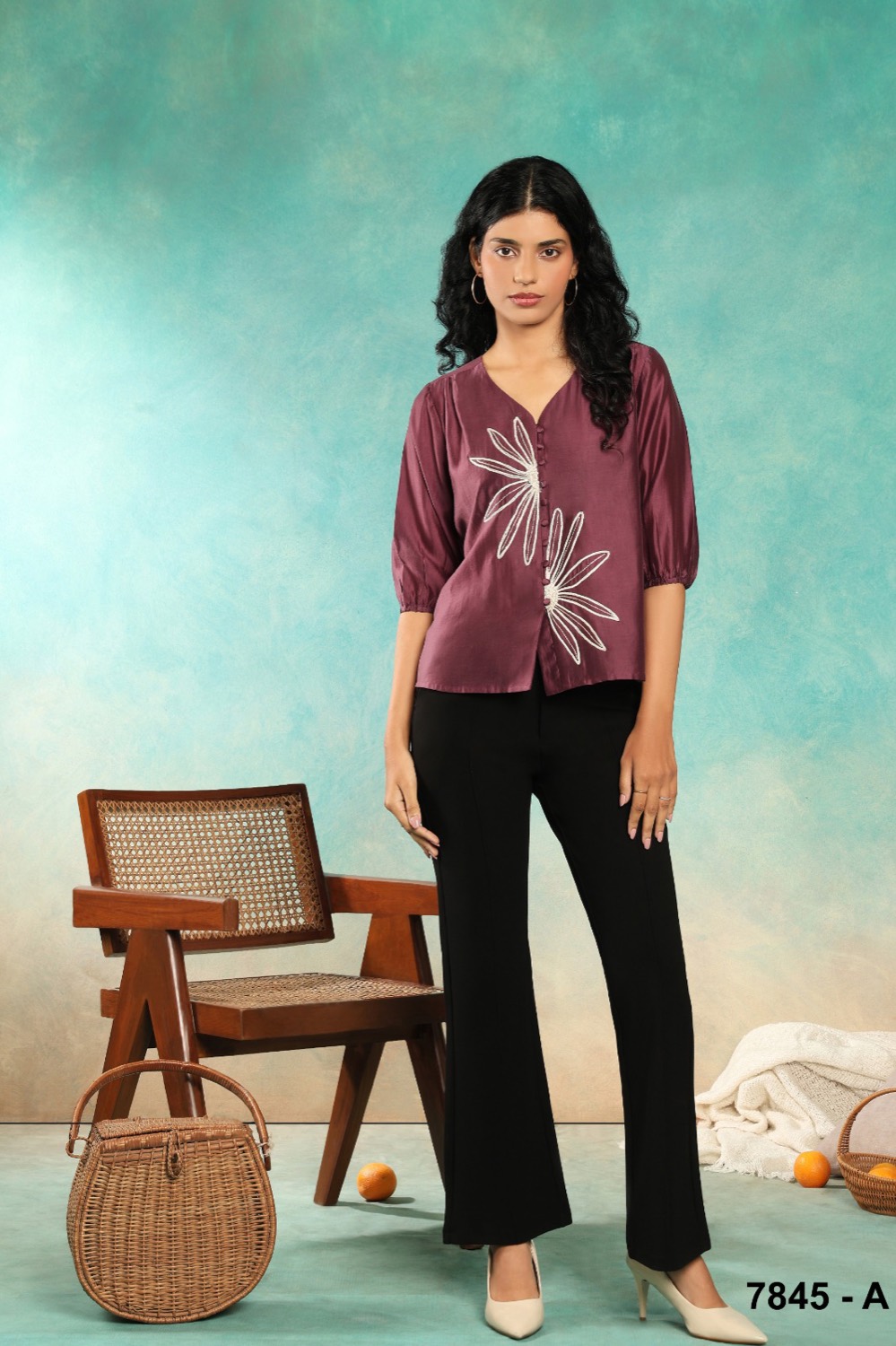
Garment study No. 1
Every top can be read as a set of decisions. Here is how the parts of Look 7845-A work together.
The V opens the collarbone and draws a gentle vertical line toward the button front, which keeps the boxy body from feeling wide.
Fabric gathered into an elasticated edge creates volume at the upper arm. It adds a romantic note while staying practical in warm weather.
Two oversized white flowers are positioned off-centre across the front. A placement motif like this acts as built-in jewellery.
A straight hem that lands at the high hip sits neatly over high-rise trousers and can be worn loose or lightly tucked.
Section B
The neckline frames the face and sets the formality of a top more than any other detail. Read the specimen sheet below: what each neckline does, and when it tends to feel right.
A curve that follows the base of the neck. Neutral and versatile, it lets jewellery and prints take focus.
Everyday, office, layering under jackets
Draws a vertical line that opens the neck and chest. Depth decides the mood — shallow for work, deeper for evening.
Office, dinners, pendant necklaces
Straight lines and corners that frame the collarbone with a slightly vintage, architectural feel.
Day events, brunches, statement earrings
A wide, shallow line running towards the shoulders. Elegant and covered, it emphasises the width of the shoulder line.
Formal events, minimal jewellery
Two soft curves meeting at the centre, like the top of a heart. Romantic and decidedly feminine.
Parties, evenings, celebrations
Rises up the neck for a sleek, covered look. Pair with bare arms or a sleeveless cut for balance.
Office, evenings, cooler months
Shirt, band, Peter Pan or revere collars add structure around the face and instantly read polished.
Office, travel, smart-casual
Fastens around the back of the neck and leaves shoulders bare. Graphic and summery.
Holidays, evenings, warm weather
Sits below the shoulders, revealing the collarbone and shoulder line. Festive and eye-catching.
Parties, vacations, festive evenings
Section C · Interactive
Sleeves decide how a top moves, how much arm it shows and where volume sits. Select a sleeve to see its flat drawing and notes.
No sleeve at all; the armhole is finished with a facing or binding. The coolest choice for coastal heat and the most versatile base for layering under blazers, shrugs and jackets.
Works with: wide-leg trousers, midi skirts, light layers.
A short extension that just covers the top of the shoulder. Neat and youthful, with a little more coverage than sleeveless.
Works with: fitted tops, pencil skirts, summer office looks.
Ends at the upper arm. The everyday standard: comfortable, unfussy and easy to layer.
Works with: jeans, shorts, casual trousers.
Finish between the elbow and the wrist, showing the forearm. A practical, polished length that suits both the office and warm weather — and shows off bangles and watches.
Works with: almost everything; a favourite for everyday wear.
Reach the wrist, often finished with a cuff. More coverage and formality, and a welcome layer in air-conditioned offices or cooler months.
Works with: tailored trousers, flares, formal and evening looks.
Fabric gathered at the shoulder and/or the hem to create rounded volume. Romantic and a little dramatic — as on Look 7845-A above.
Works with: slim trousers and simple skirts that let the sleeve lead.
Fitted at the top and flaring out towards the hem like a bell. Fluid and bohemian, with plenty of movement.
Works with: straight trousers and jeans; keep bracelets minimal.
Full through the lower arm, then gathered into a cuff so the volume billows just above the wrist. Elegant and expressive — seen on Look 9045-B in the collection.
Works with: sleek trousers, evening skirts, tucked or belted waists.
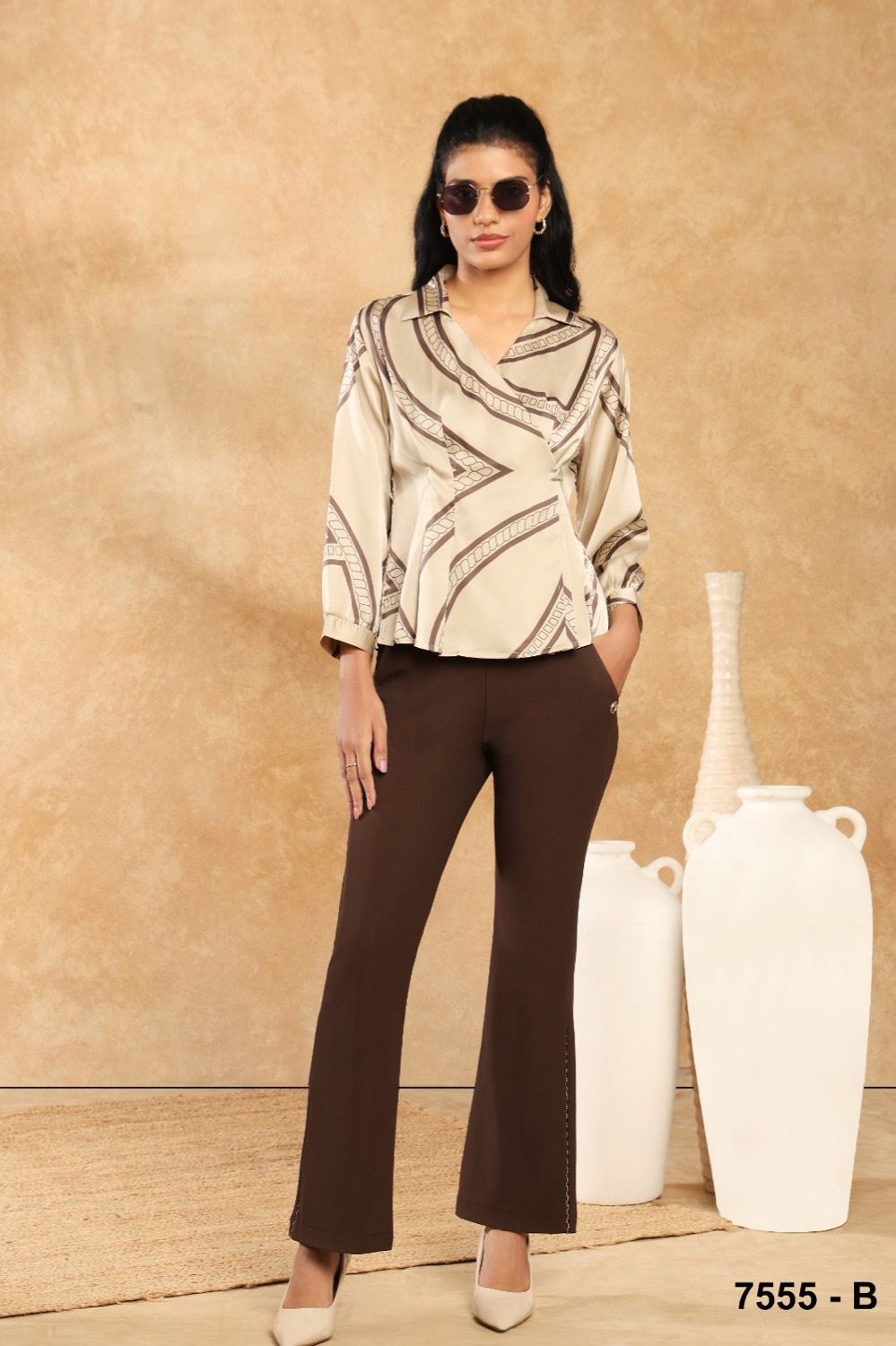
Garment study No. 2
Look 7555-B combines three of the ideas on this page. A shirt collar sits above a wrap neckline, so the top reads both polished and soft. Pleats at the waist release into a short, peplum-like flare. And the full sleeves are finished with neat cuffs that can be worn long or pushed back toward the elbow for a three-quarter look.
The diagonal chain-stripe print follows the wrap, emphasising its line — a reminder that print placement and cut often work as a pair.
Section D
Where a top ends is where the eye pauses. Moving the hem up or down changes the balance between top and bottom — a choice about proportion, not about bodies.
End above the natural waist. They emphasise the waistband and the length of the leg line, and pair naturally with high-rise bottoms or a long open layer.
Finish at the natural waist, the easiest length to tuck or wear neatly over high-waisted trousers and skirts. Peplums often start here.
The classic length for shirts and blouses. Long enough to wear untucked with mid-rise trousers and jeans; easy to half-tuck.
Fall to the upper or mid-thigh. Comfortable and relaxed, they look balanced over slim trousers, leggings and straight pants — as on the patchwork tunic in the collection.
Extend toward the knee, often with side slits. They layer like a light coat and create a long vertical line over narrow bottoms.
Section E
There is no correct top for a particular body. There are only better questions. Bring these six with you the next time you try something on.
Does it feel good after an hour, not just a minute?
Sit, reach, lift your arms. Notice how the fabric feels on your skin and whether the armholes, neckline and buttons stay comfortable as you move.
Do I reach for things like this?
Your wardrobe already knows your taste. If you love colour, a beige top may sit unworn; if you love minimalism, a busy print may feel like a costume. Both are fine.
Where does my eye land in the mirror?
Look at where the hem, waist and sleeve end. Try a tuck, a half-tuck or a belt with the bottoms you actually own, and choose the version you prefer.
Where will I wear this first?
Name three real places — your office, a family function, a weekend lunch. A top that fits several of them earns its place more easily.
How will this fabric live with my week?
Think about the weather, commuting and care: breathable fabrics for humid days, crease-resistant ones for travel, delicate ones for occasions. See the fabric library.
What will I wear it with — tomorrow?
Picture at least three outfits from what you already have. If you can, the top is versatile; if you cannot, decide whether it is worth building around.
Now that you can read a top, see how the categories come together.